the study armchair
The Murder of Roger AckroydThe study armchair is the piece of furniture whose position concealed the Dictaphone in Roger Ackroyd’s study. Initially dismissed as incidental, it becomes central to Hercule Poirot’s reconstruction: pulled away from the wall, it hid the table by the window from someone entering through the door; after the murder, Dr. James Sheppard moved it back while removing the Dictaphone. Its changed position turns an apparently minor detail into evidence of the hidden mechanism behind the crime and the unreliability of Sheppard’s account.
Position in the Study
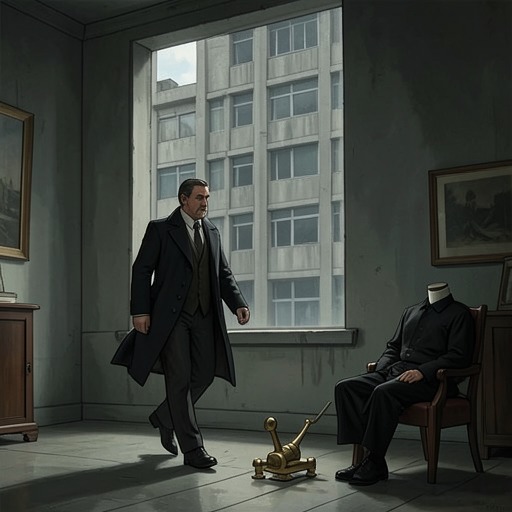
Poirot distinguishes the chair’s relation to the window from its more consequential relation to the room’s entrance. In the position Parker described, it stood directly between the door and the window. At first Poirot considered whether it had been placed to obstruct the view of the window, but the high-backed chair obscured only the narrow area between the sash and the ground. That explanation could not account for its importance.
The chair did, however, hide the table immediately in front of the window, where books and magazines were kept. Poirot’s attention to the floor plan and the chair’s exact position shifts the investigation from what a person entering the study could see of the window to what the chair prevented that person from seeing on the table. The clue is spatial: the chair matters not simply because it was out of place, but because it blocked a particular line of sight from the door.
Concealing the Dictaphone
The hidden object on the table was the Dictaphone. Sheppard’s later account supplies the specific arrangement: he left the device by the window, set to sound at half past nine, and pulled the armchair out to screen it from the doorway. The Dictaphone’s alarm-clock-based mechanism made its timed operation possible. The chair therefore served a practical purpose within the murder plan, concealing the device that would produce the misleading impression that Ackroyd was still alive at the time its sound was heard.
Poirot infers the chair’s significance before identifying the object behind it. The murderer, he reasons, could not remove the concealed item at the time of the crime, but needed to retrieve it as soon as the murder was discovered. That need helps explain the timing of the telephone message: it created an opportunity for the murderer to be present when the body was found and to get the object out of sight. The chair’s position and the timed Dictaphone thus connect the staged sound to the circumstances of the discovery.
The Chair as Evidence
The chair also helps Poirot separate people who reached the study before the police arrived. He considers himself, Parker, Hector Blunt, and Geoffrey Raymond among those present. Parker had told him about the chair, and Poirot reasons that Parker would have been at the scene whenever the murder was discovered. Blunt and Raymond remain possible suspects at that stage because an early-morning discovery might have brought them to the study too late to prevent the concealed object from being found. The chair is therefore not just an explanation of concealment; its relation to the discovery helps Poirot reason about who had an opportunity to remove what it hid.
Poirot contrasts his own sustained attention to the chair with Inspector Raglan’s dismissal of it as unimportant. The difference marks two approaches to the room: one treats the furniture as background, while the other tests its position against the layout, the hidden table, and the murderer’s need to return. What appears to be a small disturbance becomes significant because it preserves a trace of deliberate arrangement.
Sheppard’s Account and the Reversal
Sheppard’s account reveals how the chair’s position was created and then undone. After leaving Ackroyd, he looked back into the room and was satisfied that nothing had been left undone: the Dictaphone was set, and the chair concealed it from the door. He then encountered Parker outside. Later, once the body had been discovered, Sheppard sent Parker to telephone the police. While Parker was away, Sheppard removed the Dictaphone into his bag and pushed the chair back against the wall, restoring it to its proper place.
That sequence gives the chair a double evidentiary role. Its pulled-out position is a clue Poirot can interpret, while its restoration records Sheppard’s attempt to erase the arrangement that gave the clue meaning. Sheppard says he had not expected Parker to notice the chair, assuming the servant would be absorbed by the body; Parker’s attention instead carried the detail into Poirot’s investigation. A seemingly routine movement of furniture thus exposes the gap between Sheppard’s carefully phrased account and what he actually did in the study.
Narrative Significance
The chair’s importance depends on retrospective recognition. During the inquiry, a pulled-out armchair can seem incidental beside the body, the window, and the other suspects. Poirot makes it legible by tracing its sightline, the hidden table, the Dictaphone, and the murderer’s need to remove that device after discovery. Sheppard’s later explanation completes the chain, converting a detail once embedded in his narration into evidence against him.
As an object, the armchair is ordinary; as evidence, it is anything but neutral. Its position controls what can be seen from the door, and its return to the wall records an attempt to restore the room’s appearance after the concealed device has been taken. The contrast between the chair’s apparent insignificance and its precise function captures the novel’s broader investigative method: the scene yields its meaning through details that a deceptive narrator can report accurately while withholding what they imply.